Tamar will talk for almost two and a half hours. Liat put me in touch with her; I had never met Tamar before. Liat’s report on the “Protest of the Observers” had caught my attention. Tamar is also involved in this. The protest is an association of female soldiers who, as IDF observers, keep an eye on what is happening at Israel’s various borders and report anything suspicious. Tamar belonged to this unit during her basic military service and continued to perform this task in later years as part of the reserve. But why is there a protest by a separate unit, and why are they all women?
Not being heard
The latter question is easy to answer—it is mostly women who take on the role of observers. They sit in front of screens, are not allowed to take their eyes off them under threat of punishment, and register every movement. Observers also worked in the Nahal-Oz base, right next to the Gaza Strip. Long before October 7, 2023, they reported suspicious movements. Tamar tells me – and research from media reports later confirms this – that the observers reported, among other things, the training of Hamas fighters in a replica model of the Nahal Oz base. Some of the terrorists imitated Israeli soldiers defending the base. On other days, they practiced running toward the fence toward Israel. But the reports from the Nahal Oz observers fell on deaf ears; they were not taken seriously.
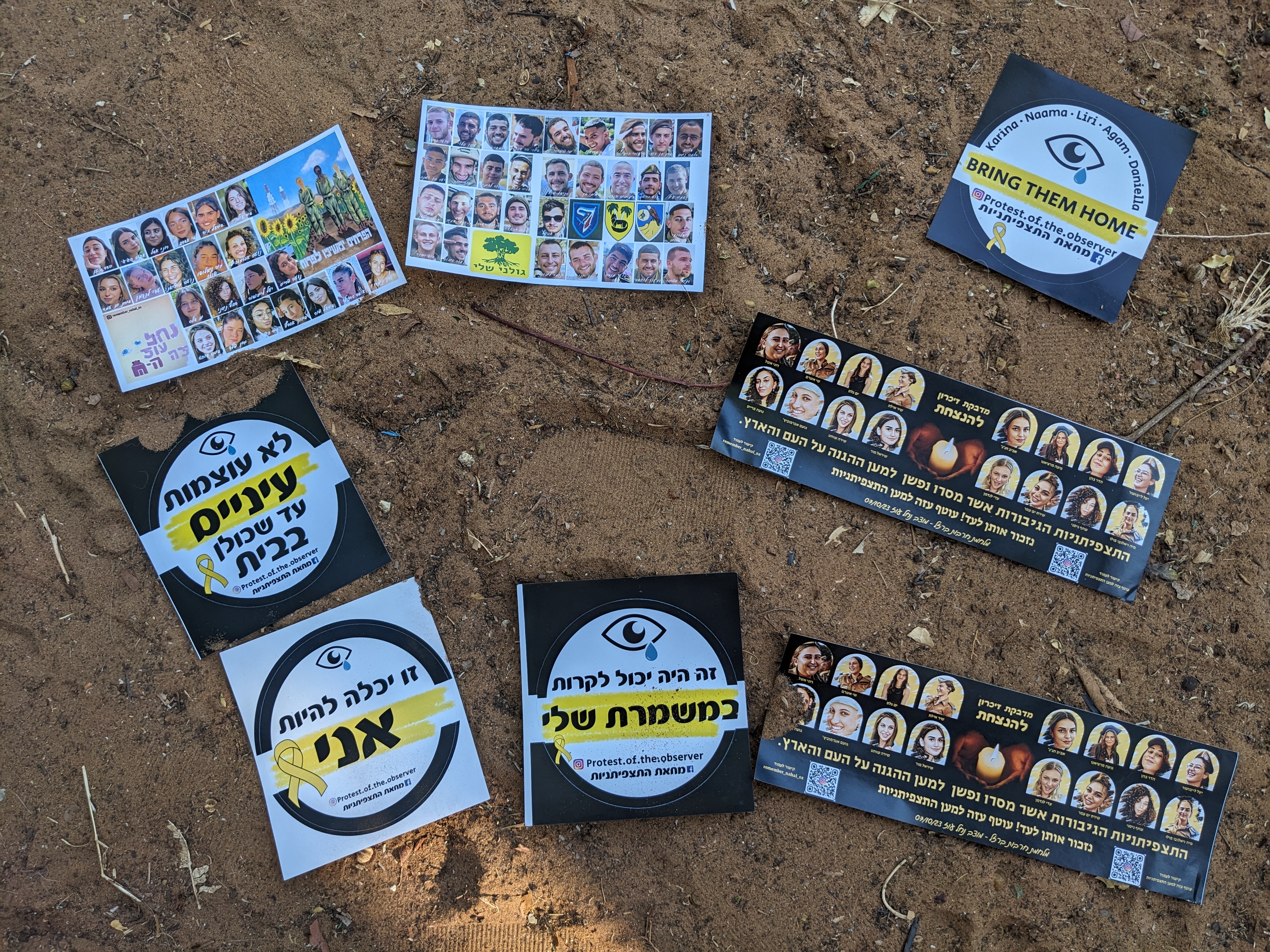
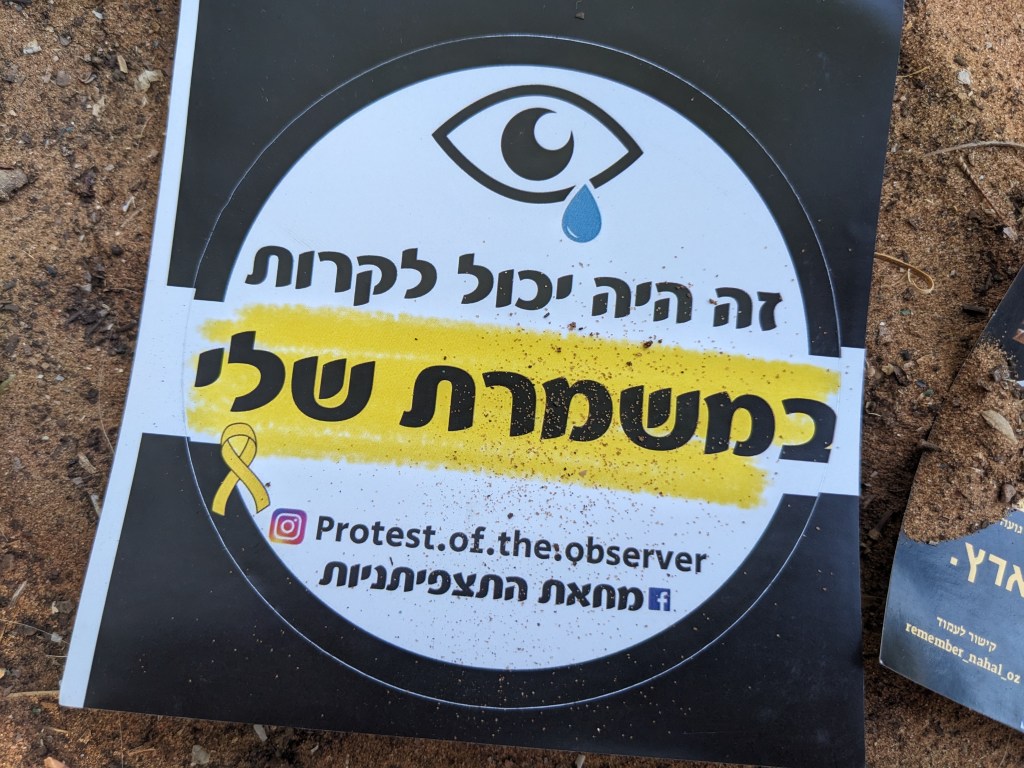
Stickers with the words “Don’t close your eyes until you’re back home!”, “It could have been me.” “It could have happened during my shift.” Plus photos of the murdered and kidnapped female soldiers. One sticker also shows photos of the soldiers who fell victim to the Hamas attack.
The feeling of not being taken seriously is shared by IDF observers across the country. Tamar tells me about other examples from her time in Jerusalem, when she looked out from the city toward the West Bank. “You’re being dramatic” and “You’re exaggerating” were phrases she often heard from her (mostly male) superiors. “They think they have more basic training than we do and, besides, they don’t want anything to happen in the three or four months they are our superiors. They don’t want to make decisions for which they will later be held responsible,” Tamar explains. In addition, the IDF also has a problem with sexism. This is probably even more pronounced in places where young men are given weapons and have to live together in small spaces. Tamar’s descriptions make it clear that this observation does not make military sexism any better for women. This is especially true when a unit consists mainly of women and depends on the higher ranks to trust and listen to them.
Attack on Nahal Oz base
On October 7 at 8:54 a.m., the Nahal Oz base is captured. The base was not completely enclosed by a fence; only one soldier was guarding the barracks that morning. Machine guns were locked away, and an IDF investigation revealed other deficiencies that led to the rapid capture. Hamas‘ calculation: if they capture the base and fight and kill the soldiers there, it will be all the easier to do what they did in the kibbutzim and at the Nova Festival. In the end, 53 soldiers are dead, including 16 female observers. Ten find themselves held hostage by Hamas in the Gaza Strip, seven of them female observers.
Well, but… what the observers saw in Nahal Oz could have prevented the entire events of October 7, had it been further investigated by other units and had the right conclusions been drawn, right? “Yes, definitely,” Tamar confirms.
Reserve duty without preparation
Tamar herself is called up for reserve duty on October 8, heading south. She supports a unit that specializes in recovering bodies and also accompanies convoys into Gaza, because Israeli bodies are there. Some tried to jump out of the jeep and were shot, others were thrown out of the cars to lighten the load. She is not trained for this stressful work, later guarding captured terrorists as well as Palestinian civilians who had work permits in Israel. She stands up for the latter, finding the blanket suspicion that they cooperated with Hamas unjustified. According to media reports, approximately 18,000 Palestinian civilians found themselves in Israeli prisons shortly after October 7 and were interrogated by the Shin Bet. Afterwards, many of them were deported to Gaza.
At the same time, Tamar tries to protect her female soldiers, some of whom are still only 18 years old, from contact with the terrorists. They celebrate their deeds, and in some cases, the women are sexually harassed. Tamar manages to ensure that only male soldiers are allowed to enter the cells. “That’s not why we joined the army,” she says, adding, “We weren’t even remotely prepared for the tasks we were assigned.” She is classified as “problematic” and is bullied. Soon she returns to her original unit with the observers in Jerusalem.
Activism
Tamar doesn’t just take action when she encounters injustice during her reserve duty. She goes beyond that. Together with other observers, she founded the protest group of the same name. Soon they are regularly at the Square of Hostages and the Disappeared in Tel Aviv, protesting for the return of their comrades from the observer unit.
Tamar fetches a bag and takes out a neatly folded cloth. It is a kind of flag, depicting the observers from Nahal Oz who were killed and taken hostage. Friends have added statements and pictures to commemorate the individual observers. Who designed the cloth? “I did,” says Tamar, looking at the cloth, unfolding it slowly and calmly, in stark contrast to her previous urgent flow of words.
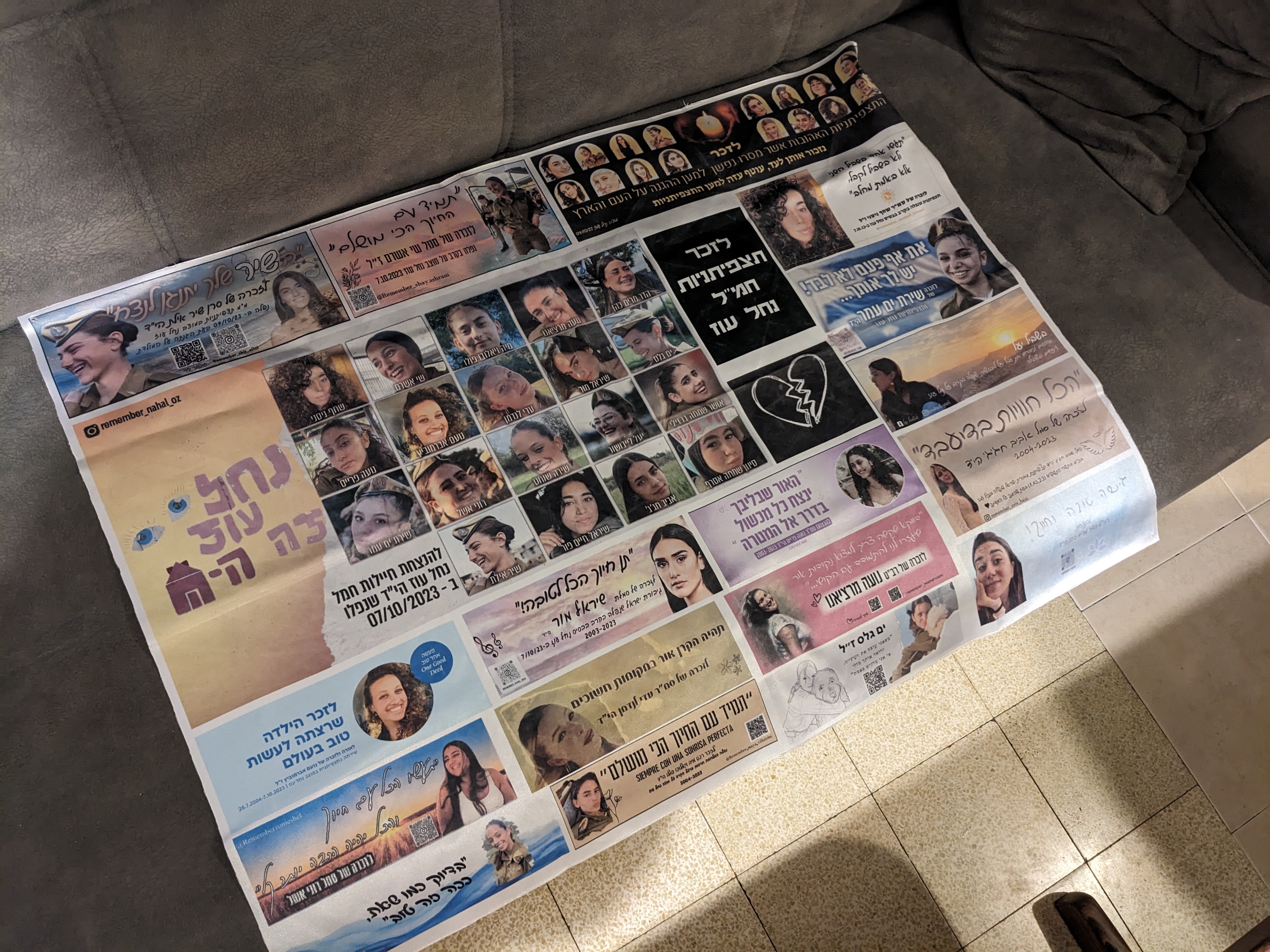
One of the captured female observers is killed by Hamas. One is freed by the IDF. Five are released during the ceasefire between Israel and Hamas earlier this year. Tamar will not stop fighting. She and her fellow campaigners have founded an NGO that supports the observers‘ cause of being taken seriously and heard. Among other things, they maintain contact with young observers who are still doing their military service, organize trips and picnics, and collect the necessary donations. She continues to demonstrate for the future of the hostages still in Gaza, taking part in protests against Benjamin Netanyahu outside his home and distributing the observers‘ stickers there. Sticking is not particularly popular there, but: “I run faster than Bibi’s security.”
Tamar also works for another NGO promoting mental health among soldiers. She confirms what a psychotherapist has already told me. The moral values of many soldiers are eroding, the war is probably the greatest strain in Israel’s history, at least for the reserves, and exhaustion is spreading. The result is a rising number of suicides among soldiers. Meanwhile, awareness of this issue is growing in the army and throughout society. I myself have heard a radio commercial several times that is aimed at soldiers and urges them not to remain alone when they have problems. New structures are currently being created, services are being expanded, and many therapists are offering voluntary services, including Tamar’s NGO. For the year 2025, the army has already classified 16 deaths as possible suicides, compared to 21 in 2024. In 2022, the number was 14, and in 2021, it was 11 [Sources: Arutz Sheva/ Israel National News | Times of Israel ].
Impact
When Tamar goes to the reserve today, she advises remotely on the destruction of the Hamas tunnels as a geologist (currently pursuing her PhD). She assesses which explosives are suitable for the respective subsoil and estimates which vehicles should drive over which terrain. Does she actually do anything fun in life? “I want to help. I want to make a difference,” she says and continues: “I didn’t want to leave my reserve duty with bitterness.” I say goodbye to Tamar. My head is buzzing with all the information, already desperately trying to prioritize and sort through it all, to grasp Tamar’s whole person, history, and stories. She makes an impact, without a doubt. And every organization should be happy to have such a fighter with such a strong sense of justice in its ranks. I sincerely hope that her future superiors in the IDF listen to her; they really should. In their own best interests.
Many thanks to Tamar, who took the time to talk to me during a short break between two reserve duties. Thanks again to Noam and Liat, who supported me in my further research and advised me on the article.
 Notes from Israel - Visit in August 2025
Hinterlasse einen Kommentar