Für deutsche Version hier klicken
The purpose of the trip was to visit my friends, to see and understand what had changed in their lives. October 7 is a turning point for Israeli society as a whole, as I wrote about here. The spectrum of emotions and analyses ranged from hopelessness and dystopias to confidence and concrete ideas about peace and coexistence. This was also evident in my mood and thoughts. My neighbor Carlotta, who waters my flowers and is retired, recently responded to my “How is it going?” with “Everything from one to ten” in the backyard. I am very grateful to her for watering the flowers and would like to use her phrase in reference to my trip here.
Criticism
It is my Hebrew teacher Eti who reminds me in a critique written in Hebrew—so I can practice right away—that I only portray a certain part of Israeli society in my blog. That’s true, I also write to Eti that my friends can be classified somewhere as “center/left” on the political spectrum of Israeli society. People on the right, those who are much more religious, national-religious and ultra-Orthodox individuals do not appear. Nor is there a single representative of Arab Israelis, and even here, one representative would not be enough to adequately reflect the plurality of the Arab part of Israeli society.
In fact, such a comprehensive picture was not the aim of the blog, as I discuss with Eti via chat and later during our lesson. The picture painted here may be composed of several different perspectives, but depicting Israeli society as a whole, especially for a German readership, would require a much more comprehensive project.
Talking at length with Eti, with whom I have only had a professional student-teacher relationship in the few months that I have known her and who does not want to classify herself as either left-wing or right-wing, caused me some apprehension before our lesson and, as she says, her as well. But the conversation went well too; “agree to disagree” is a way out. It was important to Eti that, in addition to the violence of the settlers—which she expressly condemns—I also mention that the violence in the West Bank includes the increasing number of acts committed by Palestinians. She often observes that leftists tend to portray Palestinians as automatically innocent. Certainly, describing them exclusively as innocent victims negates any personality and individuality. Eti thus opens up a field that is certainly no less important. Listening to Palestinian society, its diversity and plurality, the contradictions in which individuals find themselves, the relationship of individuals to the organizations and institutions that claim to represent them, the political stalemate that has prevailed within the Palestinian Authority for years, what path to a Palestinian state they still consider possible… Much has been written about this, and much more will continue to be written.
In August 2025, with my biography, my language skills, my limited networks, contacts, and capacities, I was not the right person to reach these segments of both Israeli and Palestinian society and conduct the kind of conversations I did.
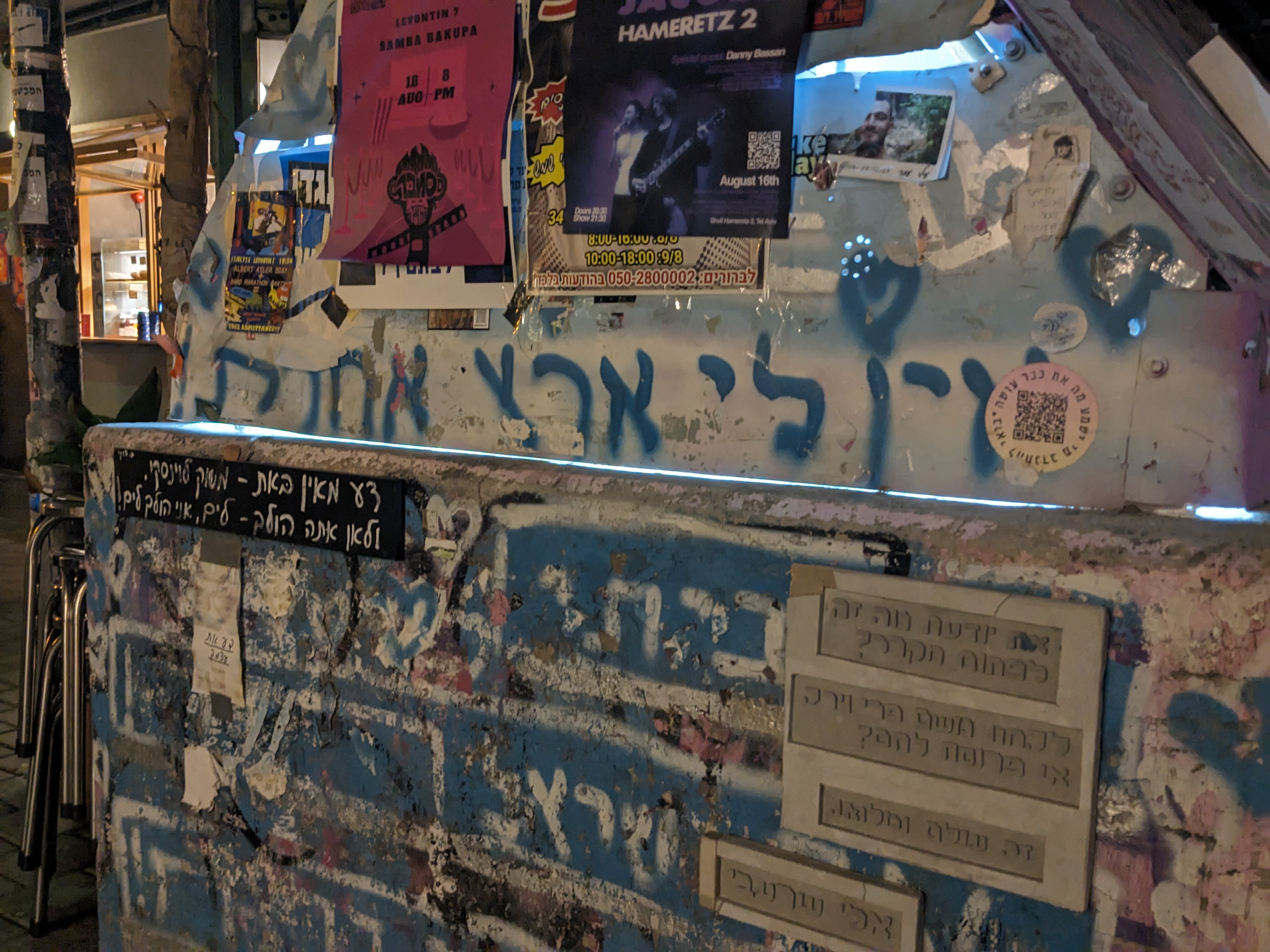
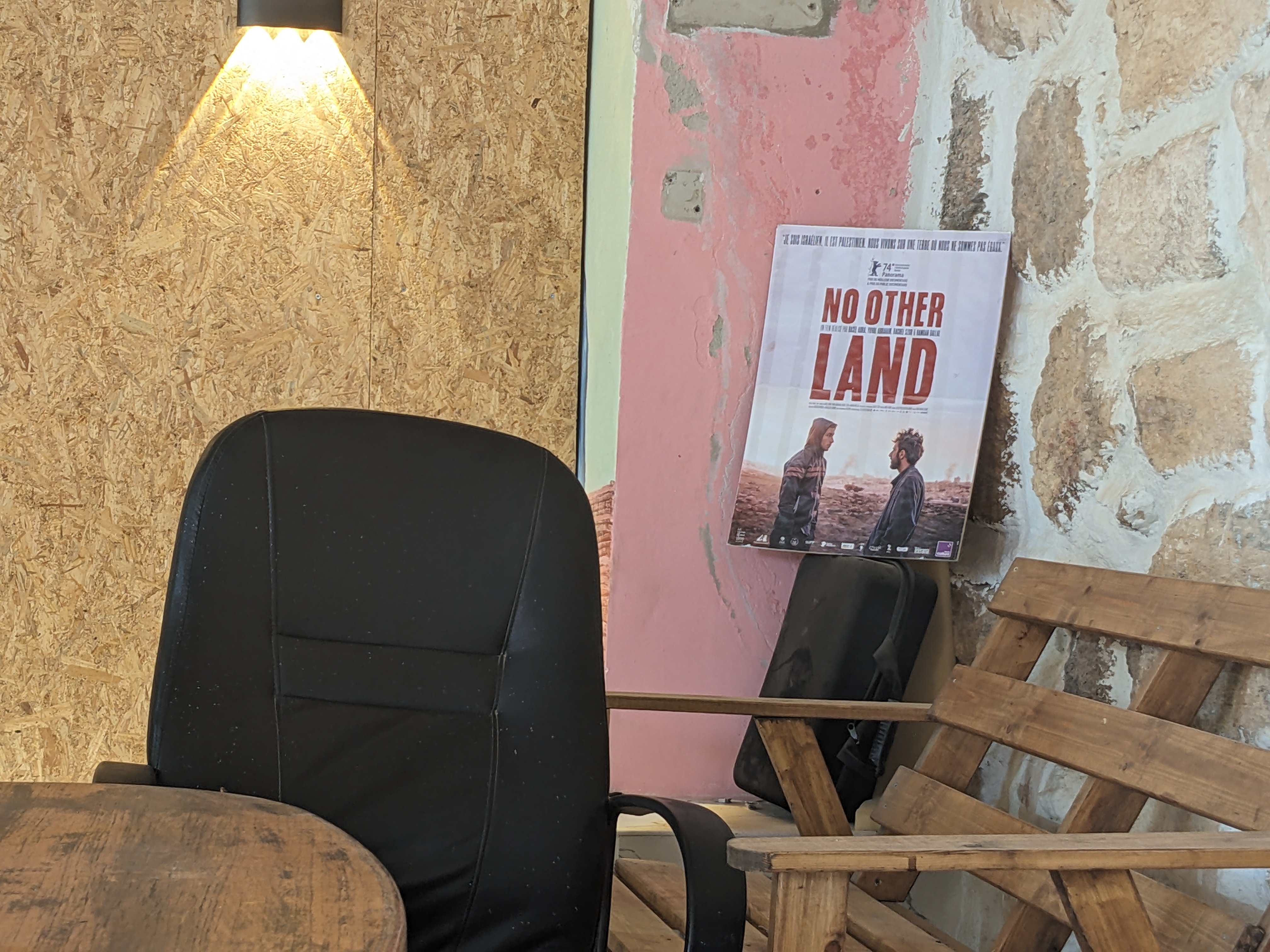
Links: Hebräisches Graffito in Tel Aviv „Ich habe kein anderes Land“, laut Noam schon vor dem 07. Oktober dort zu sehen. Rechts: Filmplakat für „No Other Land“ in einem palästinensischen Dorf bei Umm el Kheir
Listening and positioning
Part of this journey was listening. In some places, it was also about remaining silent. That is what I did. I was also asked many questions, as I already mentioned. I answered them and positioned myself.
Because I came here with a position. As a left-wing thinker, as someone who also has questions that could be perceived as uncomfortable. Questions that may be considered inappropriate because they come from someone who may be able to understand life here, but will never really know and feel what it means to have only this country. Even talking to left-leaning, progressive Israelis occasionally reached points where concentration and patience were required in the spirit of friendship. On one point, this did not quite succeed, but even then it was possible to return to friendly ground. But I am glad to have tested the shared ground with them and found it to be very stable. And that reconciliation does not have to be so difficult. Plus, the text “Versuche” (Attempts) was born out of this.
It is only in the third week, when I visit some friends again to say goodbye, that I notice we are starting to talk about topics other than October 7 and the war. Everyday things, work, relationships, comparing the German and Israeli education systems, problems with invasive canaries for the country’s fauna, things like that. I am glad that I was told so much about October 7 that such conversations are now possible. And at the same time, I realize that so much has changed that it takes long, intense conversations for a sense of ease to develop in these friendships.
No Magic
Meanwhile, the UN reports that more than half a million people in Gaza are suffering from hunger. There is no doubt that it is a famine. At the same time, there are still 50 hostages in Gaza, 28 of whom have been declared dead.
I spend the evening of August 21 with Liat again. She tells me about it shortly after Ha’aretz first published the report in Hebrew. We watch the news. Amos Yadlin, former Head of the Military Intelligence Service Aman is featured in an interview on Channel 12. The latest international reactions are being evaluated. Suddenly, Liat says in English, “What he said was really interesting!” and continues, “He just said that after a genocide, you get a state.” The Israeli government dismisses the allegations as Hamas propaganda.
Netanyahu is pushing ahead with his plans for the occupation of Gaza. Chief of Staff Eyal Zamir seems to be bowing to the cabinet’s directives and preparing his army for whatever may happen in Gaza City. “Warfare,” Noam once called it in a conversation. A term I associate with the dystopias of the Call of Duty video game series. Unlike many European countries, as well as Canada and Australia, the German government does not want to recognize a Palestinian state. It announced that it would restrict arms deliveries to Israel, sparking debate in both Israel and Germany. Meanwhile, in the West Bank, the Israeli cabinet has decided to approve settlements in the E1 area. In practical terms, this would mean the separation of the West Bank into a northern and a southern part for Palestinians.
The Israeli chief prosecutor Gali Baharav-Miara is still in office, but Justice Minister Yariv Levin of the Likud party has had the locks on her office changed. “Childish,” commented Ha’aretz at one point. According to polls, Netanyahu could still cobble together a coalition after new elections. Many of the people I spoke to are glad they took part in the strike on Yom Rishon – Sunday. At the same time, they doubt whether it actually had any impact. The news seems to prove them right; Ha’zaya was not magically broken during my visit by a sudden coincidence, nor did a wave of hope occur. And yet I am glad to have gotten hold of a few posters, including one that read “17.08. – Strike Israel! Stop the madness!” I think it was a good day for Jewish Israel after all.
Thank you!
Every now and then, my Israeli conversation partners told me that my presence and perspective also gave them food for thought. I had the impression that many of my friends were genuinely happy to talk to a European and were equally willing to invest concentration and patience in the conversation where necessary, in the spirit of friendship. Some followed the blog very closely, commented on individual articles, and supported me in my research (sometimes for several hours) and reflections. At this point, I would like to express my sincere thanks to Liat, Noam, and Tomer, whom I met repeatedly over the course of these three weeks. It was a balancing act to publish content from personal, sometimes intimate conversations. Without the feedback I received from the three of them, this blog would not have been possible. Thanks also to Micha, Johanna, Stefan, Kaja and Carlotta in Germany, who provided support from afar at various points. Thank you for the meals, barbecues and beach trips. Not to forget soccer, piano, pool, cooking, watching TV and demonstrating with two very lively 12-year-olds in a kibbutz in southern Israel.
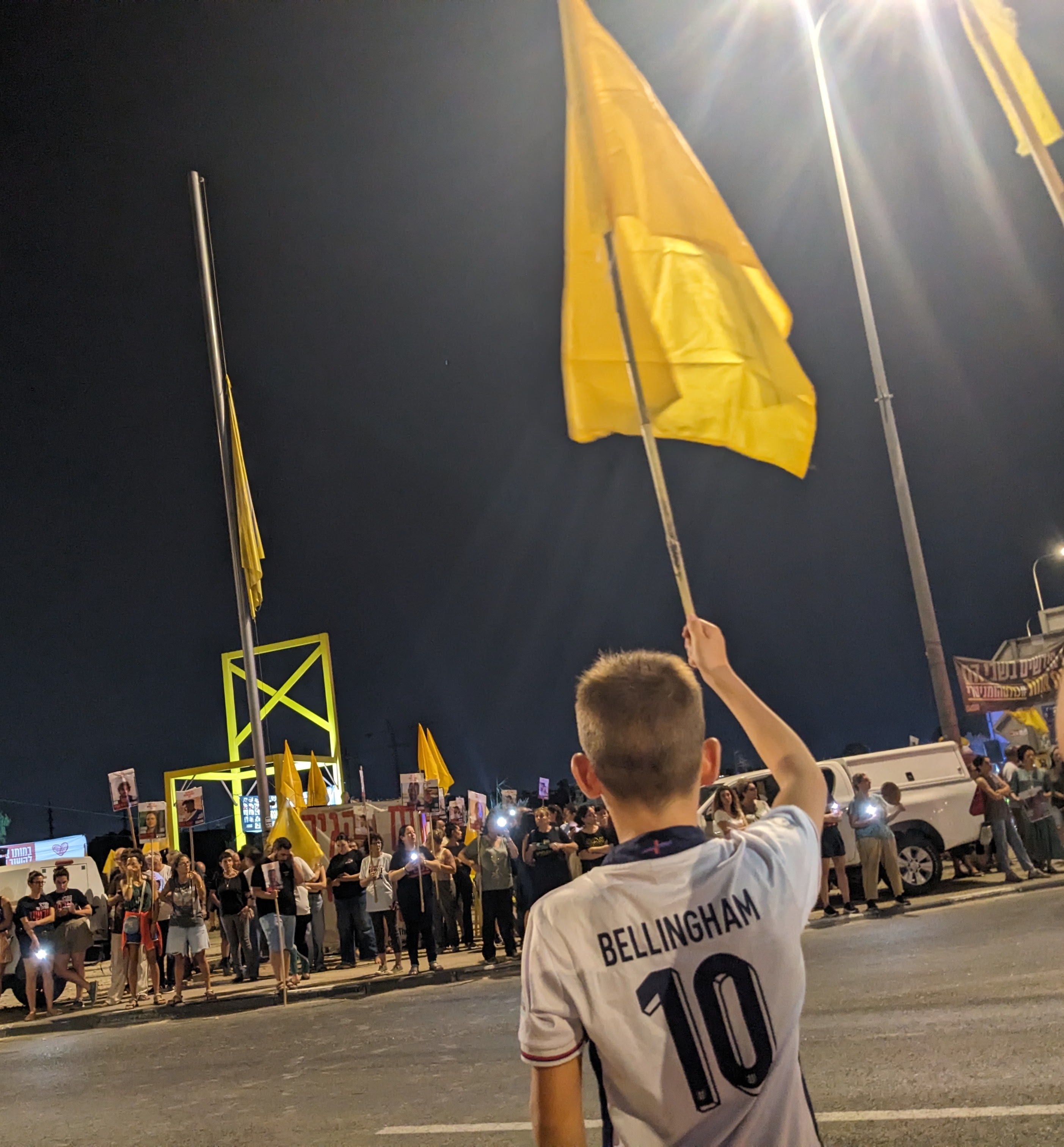
I will return. As a friend, perhaps not as a blog writer, I’m not sure. There were indeed vacation days! Once even beach office, which I cannot recommend… Everything is changing anyway. I wish my Israeli friends much strength, persevere, fight if you can, rest if you must. Perhaps it will get worse. But perhaps it will simply get better. I did find a little hope after all.
Thanks to Tomer, Tomer’s twins, Yiftach, Noam, Kian, Lew (who hasn’t appeared here yet, but still searched and discussed and plays guitar wonderfully with Noam, Kian, and Kolja, thanks for the free concerts I was able to attend!), Maryah, Liat, Liat’s partner Ofir, her mother Chana, Kelila, Yarden, Romi, Khalil, and the other people in Umm el Kheir, Eti, Tal and Kolja. I visited the latter two at the very end and, after a very intense trip, was able to spend two very relaxing vacation days with them in Herzliya and look back on the trip. They were reason enough not to go to the demonstration in Tel Aviv on my last Saturday, as originally planned 🙂
Thank you all for your hospitality during these difficult times. Thank you to everyone else I had the opportunity to speak with!
Finally, a cautious film recommendation for German readers
On Tomer’s recommendation, I went to see the film “We’ll Dance Again – עוֹד נחזור לרקוד,” which was shown on July 19 at the National Library of Israel in Jerusalem as part of the Dokutext Film Festival. It depicts the Hamas terrorist attack on revelers at the Nova Festival on October 7, 2023. I don’t want to try my hand at film criticism, but just one thought: The film shows horrific images of murder and hostage-taking, of terror against civilians, and the filmmakers apparently weighed many considerations in their attempt to find a visual expression for sexual violence. A woman sitting a few rows in front of me left the screening after maybe thirty minutes. Not everyone can watch this film; many Israeli people I talk to tell me they couldn’t. Even Tomer says so after I’ve seen the film. The film does not ask critical questions about how such an act of terror could even be possible. It shows only the horror inflicted on a community of people who love to celebrate.
What I mean to say is: October 7 was and is not just another escalation, far away even if it is in the Middle East, just a “new round” between Hamas and Israel. Perhaps we need these powerful images, condensed and selected in a film, at a time when war is drawing ever closer (I am writing as a person from Germany). To at least know and feel for a moment what is everyday life for those who live in war today. Who wait for people in captivity. Perhaps living in war in a reality like the one here in Israel also means, as a feeling and thinking person, with all the questions I have about myself, where I should even begin to look for an answer in this humanity. In the end, these questions arise for all of us. I would always argue that friendship is an essential part of this search’s beginning.
Unfortunately, war is no longer just history. And yet there is hope, which is also a message of “We’ll Dance Again – עוֹד נחזור לרקוד.”
Thanks to Eti and Tomer for their feedback on the article.

 Notes from Israel - Visit in August 2025
Hinterlasse einen Kommentar